Yingshan, Sichuan: Balancing Governance and Protection to Safeguard Clear Waters and Nourish the People's Livelihood
In recent years, the Yingshan County Committee and Government of Nanchong City, Sichuan Province, have adhered to the concept of ecological priority and green development, coordinated water resource protection, water pollution control, and water ecological restoration, and continuously promoted watershed water ecological governance, achieving clear water, green banks, and beautiful scenery, greatly satisfying the sense of gain, happiness, and security of the people.
On May Day this year, Liu Jun, a businessman from Yingshan in Shenzhen, returned to his hometown after a long absence. He strolled along the banks of the two rivers in the north and south, visited Xiyue Lake Park and Xinglong Lake Park, and saw fish swimming on the shallow bottom and clear water with green banks. He often took photos with his phone and shared them on his social media. "I want to give a thumbs up for the improvement of the water environment in the county!" He went back to the countryside to visit his relatives. Along the way, he saw rivers and reservoirs rippling with blue waves, water birds flying by, lush trees and green grass on the shore. "The beautiful scenery of mountains, clear water, and harmonious human and water that came into view is stunning
Make up for shortcomings and fight the battle of urban sewage interception and management well
I have lived in Danan Street, the county town for more than 20 years, and I never dreamed that the Nanmen River tributary, the Maling River, would be so beautifully renovated. Before the renovation, the river was extremely polluted, especially in summer when the odor was strong and mosquitoes were flying around. We didn't want to go downstairs at all. "On the evening of May 9th, while taking a walk along the banks of the Maling River, the ancient and rare old people said that thanks to the implementation of the" Comprehensive Renovation of the North and South Rivers "project, the river has widened, the water has become clearer, the environment has improved, and it has become a good place for leisure and fitness.
The two rivers of north and south pass through the city, and the river water nurtures generations of mountain campers. Due to historical limitations, many buildings and houses have been built along the river, riding on the river, and covering the river. Sewage is discharged directly from both banks, and the river water is polluted and smelly. The water environment and ecology have been severely damaged, and it has been jokingly referred to as the "three no's" where windows cannot be opened, scenery cannot be seen, and activities cannot be carried out.
The Yingshan County Committee and Government have not avoided or backed down, and have invested nearly 10 billion yuan to carry out comprehensive improvement of the North and South Rivers. Implement sewage interception and source control, following the principle of full closure of "household sewage pipes → sedimentation and slag separation tanks → municipal sewage pipes → sewage interception main pipes → sewage treatment plants (stations)", to achieve the collection of all collected sewage. Demolishing some old buildings along the river, regulating 16.5 kilometers of urban waterways, and creating an ecological corridor that integrates flood control, pollution control, and landscape.
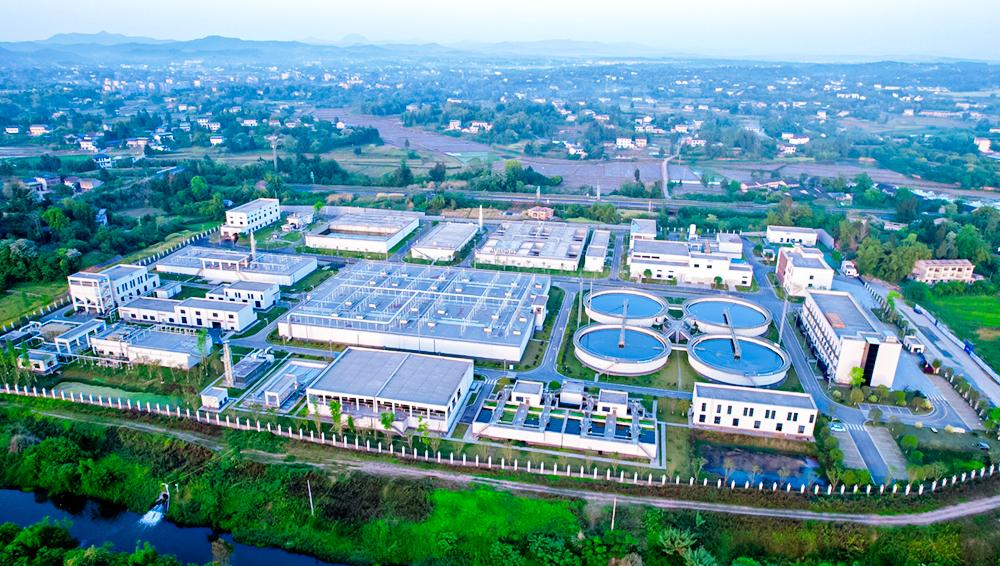
It is reported that during the 14th Five Year Plan period, Yingshan will focus on fighting the battle of urban sewage treatment, mainly focusing on controlling sources and intercepting pollution in built-up areas. In combination with the renovation of old residential areas, we vigorously carried out the mixed treatment of rainwater and sewage, completed the renovation of 324 old residential areas, newly rebuilt 260 kilometers of rainwater and sewage pipe networks, built four sewage interception main pipes and supporting branch pipes for the south, north, west, and middle lines, reconstructed a fully enclosed collection and treatment system for household discharge → hospital collection → branch pipe guidance → main pipe transportation → factory treatment, ensuring that "rainwater enters the river and sewage enters the factory". By optimizing integration and intensive layout, the original 9 scattered sewage treatment plants have been integrated into 4 centralized sewage treatment plants, namely Chengdong Sewage Treatment Plant, Chengxi Sewage Treatment Plant, County Domestic Sewage Treatment Plant, and Industrial Park Second Sewage Treatment Plant. The sewage treatment capacity has been increased to 86500 tons/day, achieving the transformation and upgrading from decentralized treatment to centralized treatment, and fundamentally transforming the problem of "difficult sewage treatment" that has plagued the county for more than 20 years.
Along with the promotion of rainwater and sewage diversion in urban areas, there is also the sewage treatment project in Yingshan Township. At present, a total of 82 township sewage treatment stations have been built in the county, and 101 kilometers of sewage pipe networks have been newly renovated. The daily processing capacity can reach 199900 tons, achieving the collection of all township sewage.
Strengthening control and enhancing the comprehensive management capability of water environment
During the Spring Festival of 2026, many villagers from Yingshan who were away returned to the county town, and the amount of domestic sewage discharged by residents increased significantly. Yingshan adheres to unified command, unified scheduling, and unified disposal, with four centralized sewage treatment plants operating at full capacity 24 hours a day, fully ensuring the collection and disposal of sewage. When the peak of sewage disposal in the urban area reaches 76000 tons, a 20000 cubic meter regulating tank will be scientifically activated as an emergency backup facility, effectively reducing peak shaving and storage, ensuring smooth disposal, precise water volume control, safe operation of facilities, and stable water quality compliance.
Through the joint cooperation of all levels and departments, full support from the Environmental Investment Company, and frontline personnel sticking to their posts, the county's sewage has achieved zero overflow for the first time, completely reversing the situation of sewage overflow during the Spring Festival period that affected the urban environment. This marks a historic new breakthrough in the county's sewage treatment and guarantee capabilities, and has won wide recognition from cadres and the masses.
During the Spring Festival, sewage treatment has delivered impressive results, which is a microcosm of Yingshan's efforts to strengthen control and enhance its comprehensive water environment management capabilities. In recent years, Yingshan County has strengthened grid supervision, led by the County Agriculture and Rural Bureau, with the cooperation of various townships (streets), closely monitoring rural non-point sources, livestock and poultry breeding and other rural pollution, actively guiding owners to standardize the consumption of breeding manure, ensuring the comprehensive utilization of breeding manure is implemented, and slaughter wastewater is discharged in compliance with standards after disposal. Further increase law enforcement efforts, investigate and deal with water related cases such as the failure to operate sewage treatment facilities and illegal discharge of sewage in accordance with the law, and resolutely curb the phenomenon of illegal discharge. Strictly implement the river chief system, effectively fulfill the responsibilities of township and village grassroots river chiefs, timely clean up and transport floating garbage intercepted by bridge piers and dams, and closely monitor illegal activities of wastewater discharge into rivers or damage to sewage pipelines leading to the discharge of domestic sewage and pollution of river water. Strictly prevent high concentration wastewater from being directly discharged into rivers.
Yingshan strengthens the operation and maintenance management of pollution control facilities, establishes a dedicated team to inspect the urban sewage pipeline network, sorts out key prevention and control risk points along the river, and promptly rectifies problems found. At the same time, we will comprehensively implement refined control of sewage treatment facilities, scientifically regulate the actual inflow of each sewage treatment plant (station), and efficiently operate high emission standard plants and stations (such as the Chengdong sewage treatment plant that implements the Mintuo River standard) to achieve intensive and efficient treatment of sewage.
In recent years, with the concern and support of the ecological environment and water departments in Nanchong and Dazhou, the governments of Yingshan and Qu counties have closely cooperated to establish a cross-border river joint prevention and control mechanism. Establish and improve cooperation mechanisms such as joint law enforcement and emergency response between the two counties to ensure timely detection and rapid disposal of environmental issues within the watershed; Promote the sharing of watershed data to provide strong support for water quality supervision, management, and scientific decision-making in the watersheds of the two counties; Jointly develop scientific and reasonable remediation plans for ecological flow discharge, cleaning of debris on both sides of rivers, and control of non-point source pollution to ensure effective protection of the ecological environment. Nowadays, the overall water quality of the Yingshan section of the Liujiang River has significantly improved.
Optimal scheduling injects fresh water from the source into ecological governance
On May 9th, the author arrived at the dam of Doukeng Power Station in Lingjiu Town, Yingshan County, and saw the sparkling water on the dam, blending with the distant peaks of Diecui; The river water released from the dam gate gurgled out, meeting the ecological flow demand downstream.
There are a total of 7 small hydropower stations within the jurisdiction of Yingshan County, belonging to the Qujiang River system, a first level tributary of the Jialing River in the Yangtze River Basin. In order to ensure the ecological flow of small hydropower stations, Yingshan County has completely shut down small hydropower stations, determined the minimum discharge ecological flow standard for small hydropower stations, installed online monitoring equipment, and connected it to the provincial and municipal ecological flow supervision platform to ensure real-time online monitoring and supervision. At the same time, each small hydropower station has set up overflow outlets, installed siphon pipes, lifting flushing valves, fixed limit facilities, and video surveillance, comprehensively eliminating dehydrated river sections and continuously improving the water ecological environment of the basin.
Yingshan actively carries out ecological water replenishment in the watershed, implementing the linkage scheduling of "water quality, water level, and flow" for Doukeng and Wumashi power stations. Based on real-time water quality monitoring and manually encrypted monitoring data from the Baitu national control section, the water replenishment amount of Jinjigou and Mugaoqiao reservoirs and the ecological flow discharge threshold of Doukeng and Wumashi power stations are dynamically adjusted to fully improve the water replacement efficiency of the "reservoir area", and to suppress the large-scale reproduction of algae in the river, prevent eutrophication of the water body, and improve the self purification capacity of the water body. During the 14th Five Year Plan period, the annual average water quality of the Baitu national examination section of Liujiang River, as well as the examination sections of Zhongtan Hexiqiao Town, Sifengxi Lanwu Bridge, and Qilong River Danixi, all reached the Class III standard. Yingshan River was selected as one of the second batch of mother river recovery action rivers and lakes by the Ministry of Water Resources.
After being treated by a sewage treatment plant, waste can be turned into treasure. The author walked into the sewage treatment plant in the east of Yingshan County and saw that various mechanical equipment was operating normally, and the treated sewage was rippling in the secondary sedimentation tank. Wang Yiwei, a staff member of Yingshan Ecological Environment Bureau, introduced that the sewage transported through the pipeline in the county enters the treatment plant and undergoes processes such as impurity removal, mud water separation, phosphorus and nitrogen removal. The sewage is turned into clean water and directly used for ecological water replenishment.
Yingshan County has placed great emphasis on improving the utilization of sewage resources. A reclaimed water reuse project has been built, with a total of 6.86 kilometers of pipelines laid. The tail water treated by the county's domestic sewage treatment plant and the Chengdong sewage treatment plant is purified through artificial wetlands to meet Class IV surface water quality standards, and pumped to the upper reaches of the Zoumaling River, achieving a daily ecological water replenishment of 30000 cubic meters and injecting source water into the Nanmen River.
Rivers and lakes display new beauty, clear water nourishes the hearts of the people. We will use our hearts, emotions, and efforts to protect the ecological environment of Yingshan like we protect our own mother, "said Ran Gaogao, director of the Yingshan Ecological Environment Bureau in Nanchong City. He stated that we will continue to do a good job in intercepting pollution sources, internal governance, ecological restoration, and improving the quality of living water, promote the water environment governance of Yingshan to a new level, take new steps and achieve new results in the construction of a beautiful home. (Peng Jie)
All articles,data and pictures on this website are from the Internet,and all copyrights belong to the source website or source author.if it infringes on your rights,please let us know and delete it.